Overview
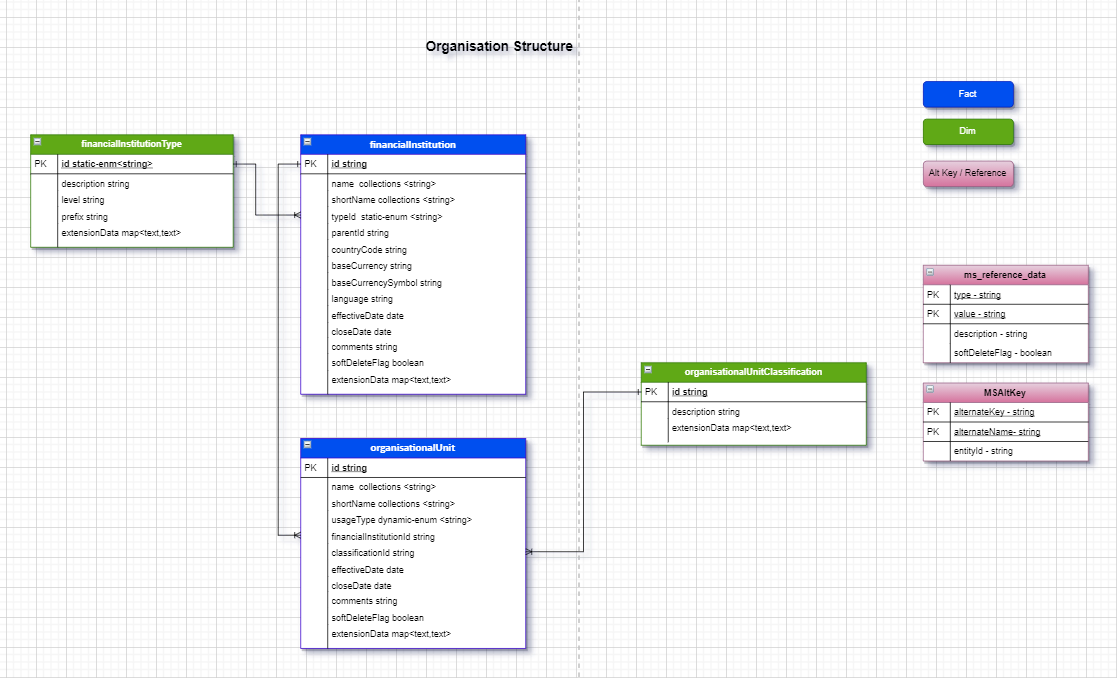
Organisation Structure Microservices needs to provide an independent cloud-enabled solution for managing Organisation Structure's information that is used across the banking solution through dedicated configuration data. It contains all reference data describing the structure of financial institutions.
Based on the data access interfaces planned, the NoSQL database model is chosen as the data model for managing Organisation Structure's information. NoSQL is the standard language for dealing with unstructured text. NoSQL can be used to insert, update, and retrieve database records. NoSQL databases are more scalable and provide superior performance.
Moreover, this distribution service of Organisation Structure Microservice is fully containerized and can be deployed independently irrespective of any back-office system of the Bank.
Purpose
The Organisation Structure Microservice contains all reference data describing the structure of financial institutions. Based on the common industry standards this is designed and adapted to the needs of Temenos Infinity.
The management endpoints exposed here have the sole purpose to configure the financial institution related data and create a reference setup, that will then be used across the Temenos Infinity solution through dedicated configuration data. Below are the different types of Financial Institution related data that can be stored.
Financial Institution
The Financial Institution is an instance of any of the Financial Institution Types. So the type of the financial institution will define its place in the hierarchy and what it is linked to.
Organisational units can only be linked to Financial Institutions of Type Legal Entity. Below are the different types of Financial Institutions.
Financial Institution Group
The Financial Institution Group is describing the top level domain. It shall actually be the main project identifier and the top level of the financial institution.
Example: Big Bank Group.
- A Group can only have one instance.
- A Group must not have a parent element.
- The Financial Institution group has to be created as the first record in the Organisation Structure model.
Financial Institution Subgroup
Examples: Big Bank Insurances, Big Bank Middle East, Big Bank Private Business.
The Financial Institution Subgroups will be used to help organising the bank into smaller entities. It is in the remit of the bank on how they want to organise the financial institution infrastructure.
The Financial Institution Subgroup is linked to the Financial Institution Group. There will be no direct permissions check at runtime against the Subgroup. If during the creation of a user, the user is being assigned to a Subgroup, all this means is that dynamically all Legal Entities that are linked to the Subgroup will be resolved.
Subgroup always needs to be linked to Group.
Financial Institution Subgroups are optional.
Financial Institution Legal Entities
Examples: Big Bank Germany, Big Bank Credit Unions.
The Legal Entity is the "home" of records. Essentially everything will be assigned to a Legal Entity - either directly (as an attribute of the object) or indirectly via an Organisational Unit. One way or another an object is related to a specific legal entity.
Legal Entity can be linked to Group or Subgroup but has to be linked to either one.
Especially in the case of user, it must not be confused that a user has an attribute that identifies him as a "member" of a specific Legal Entity but he can have "access to" an entire set of other legal entities.
Financial Institution Types
The Financial Institution is essentially represented by three types in the Organisation Structure through a hierarchical order:
- The Financial Institution Group
- The Financial Institution Subgroup
- The Legal Entity
The Organisational Units represent the entities within a Legal Entity.
Organisational Unit Classification
The Organisational Unit Classification defines what the Organisational Unit actually does. The Organisational Unit itself is an instance of a an Organisational Unit Classification.
The classification of Organisational Units is an extensible model and can represent whatever a financial institution needs to represent. (e.g. a branch, department, area office, regional office, contact centre unit, internet banking service).
The default Organisational Unit Classifications used by Temenos Infinity are "Branch" and "Department".
Entity Model
In this topic